Inaugural Alabama Farm Poll Measures Farmer Sentiment
By Marlee Jackson
When Mykel Taylor and Kelli Russell dug into data from the inaugural Alabama Farm Poll, some discoveries were unsurprising to the Auburn University (AU) researchers.
Forty-three percent of the 321 farmer-respondents reduced farm inputs in 2025. More than 35% postponed hefty farm purchases, while 23.1% punted expansion due to a depressed farm economy.
The statistical shocker, however, came from a concerning ripple effect into farm households.
“They also cut back on social activities; they used savings; and they postponed major household expenses,” said Taylor, the Alfa Endowed Scholar who leads AU’s Department of Agricultural Economics and Rural Sociology. “Ten percent even postponed medical care. That means they’re not doing things that are recommended or needed, like knee surgeries, shoulder replacements and medications.”
That’s troubling, Russell added.
“Any number above 0 is not OK,” said Russell, whose research as a rural sociologist focuses on how farm management decisions impact households and communities. “Thinking about 1 out of 10 (postponing medical care) is really hard.”
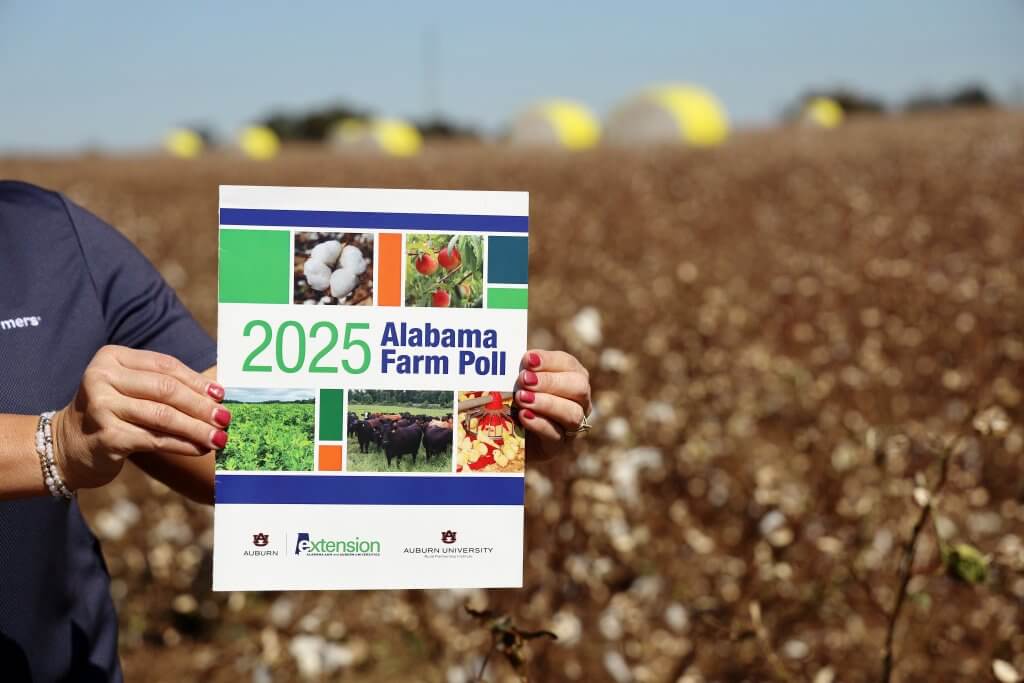
Together, Taylor and Russell fashioned the Alabama Farm Poll to paint a holistic picture of Alabama farmer sentiment. The poll measures quality of life, economic pressure, adaptation to stress and future hopes for farming.
Similar surveys have charted farmer perspectives in Midwestern powerhouse states like Indiana, Iowa and Ohio since the ‘80s farm crisis.
“They can see how ag in those states has changed over two generations,” Russell said. “There’s a lot of strength to knowing what farmers are producing and how those producers see the industry and make farm management decisions. Different areas of the country have different sentiment. The scale and commodities we produce are different in the Southeast than the Midwest.”
Russell said poll results are more than stats. Over years, the poll will capture trends and pinpoint Alabama farmers’ challenges and needs.
Taking that information to decision-makers who can influence change is a critical next step, Russell said.
“We are documenting this story for those inside the industry to share with folks outside of this industry,” she said.
Alabama Farm Poll survey recipients were randomly chosen from U.S. Department of Agriculture sample records. While pleased with 300-plus initial respondents whose commodities ranged from cattle and row crops to timber and poultry, Taylor said she hopes the pool grows each survey year.
“The Iowa survey has lasted as long as it has because people look forward to getting the survey, filling it out and seeing the results,” Taylor said. “We have to do the same thing. This isn’t research for research’s sake. This is really for our ag industry and for our state.”
Taylor and Russell followed the 2025 pilot poll with a larger, more nuanced survey in 2026. As they comb through that data, they’re already planning for the next Alabama Farm Poll in 2028.
Funded by AU’s Rural Partnership Institute, the poll will survey farmers biennially.
The duo said the Alabama Farm Poll underscored the credo that farming isn’t just a livelihood; it’s a way of life.
Importantly, three out of four farmers polled said their quality of life remained the same or improved in the last five years, despite a difficult farm economy.
“What I hope is the 2025 and 2026 surveys will be the lowest point we see, and that by the time we get to 2028, we will be in a better situation,” Taylor said. “In the meantime, we want people who make decisions and have an influence over the industry to see this full picture of both the farming side and the household side and say, ‘OK, we see these high points and some low points. Let’s address these issues.’”